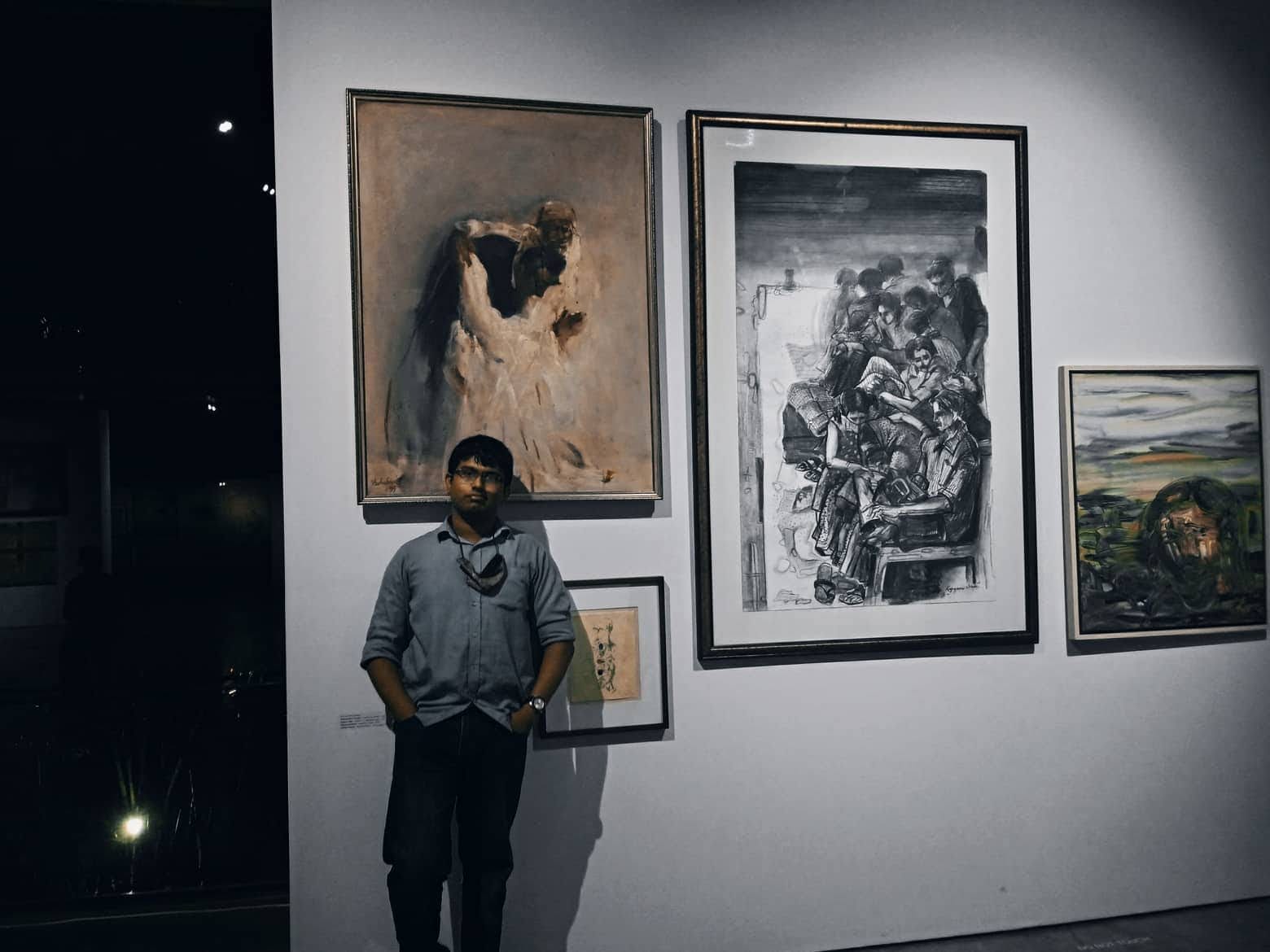
A survivor's story.
This little corner of the internet belongs to me. It will be long.
It might wander. But this is my journey.
The Question
If someone asked me to describe my life in one image, I would probably choose a quiet night, rain falling steadily outside, a dim light somewhere in the distance, and a person sitting by the window thinking about the world.
A person's real life does not begin with breath. It begins the moment a question slips under the skin and refuses to leave. Mine arrived on a monsoon morning, standing barefoot while rain hammered like impatient fingers.
What is the objective of life?
What is the real purpose of all the things we spend our lives doing?
The question never shouted. It simply stayed, growing quieter and heavier with every year.
Family Atmosphere
Our house was unmistakably middle class. And like many middle-class homes in South Asia, it lived under a gentle but firm conservatism. Rules existed. Boundaries existed. Discipline existed. And of course, shouting, arguments, and the occasional family drama. At the time those rules sometimes felt suffocating. Later, I realized they had also protected me.
Middle-class life teaches quiet lessons that wealth often hides - how to adjust, how to wait, how to survive disappointment, and how to value effort over image. When the real world eventually throws its inevitable bricks at you, those lessons begin to make sense.
My sister, who now lives somewhere in the sky, loved rain. She loved me deeply, always calling me and wanting to be near me. One memory still follows me: whenever the rain arrived, she wanted to be outside with me, even while she was terribly sick, smiling with a kind of stubborn joy despite the suffering she carried. That smile remains one of the last memories I hold of her.
My other two sisters are still here, and their favorite hobby seems to be teasing me relentlessly. Strangely enough, that teasing is one of the happiest parts of my life.
Evenings in our home often carried music. My mother would sing Bengali songs with a calm voice that somehow turned ordinary evenings into something sacred. My aunts would join her, their voices weaving together like two rivers meeting. And occasionally my sister would burst in laughing, ruining the harmony and making the entire house erupt in joy. Family is never perfect harmony. It is a messy orchestra. But somehow the music survives.
Rain, Sea & Me
Whenever the sky darkens and the first drops begin to fall, I am drawn to the window or, better still, outside. I stand beneath it without hurry, letting the rain touch my skin as if it were anointing me. In those moments, the world softens. Boundaries blur.
Rain has always been more than weather to me. It is a quiet companion, a faithful mirror, and a gentle confessor. I have long found my deepest solace in the steady, unhurried descent of rain. My sorrows, long carried in silence, find their voice in the falling water. The rain never judges. It simply receives and cleanses.
I find something sacred in its arrival, an invitation to pause and to remember life, dissolving the noise of ambition, expectation, and performance for a few moments.
Where rain speaks in intimate whispers, the sea speaks in vast, eternal rhythms. Standing before the waves, I feel myself recalibrated at the level of the soul. Each surge and retreat carries away the accumulated dust of worry, ambition, and illusion. The sea holds me in perspective. I am part of something immense, ancient, and undefeated.
I keep a continuous conversation with rain and sea. Both remind me that healing often lies in flow, and peace is found not by escaping emotion, but by letting it move through us as naturally as tides.
In their presence, I remember who I am beneath roles and stories: a soul like water, trying to find its way home.
Silence & Solitude
Silence has often been my truest mirror. I do not always seek silence because I am at peace. Sometimes I seek it because noise can drown truth. In silence, I can examine my failures without defense, my desires without shame, and my future without interruption.
In solitude, stripped of performance and expectation, I meet the versions of myself I cannot hide. Loneliness and solitude are not the same thing. Loneliness is emptiness, but solitude can be revelation. I never feel empty when I am alone.
Some of my clearest realizations have arrived in self-conversation: in late-night quiet rooms, on early mornings over rain-soaked rooftops, and in open wilderness beside a river. Sometimes, I just need space from distraction to hear what is true.
Faith & Philosophy
Religion always exists in a thoughtful corner of my life. I am not an extreme devotee of God, but I deeply appreciate the philosophical depth within Hindu traditions. The discipline, symbolism, and reflective nature of its practices often help calm the mind during difficult moments - not because I expect supernatural intervention, but because reflection itself brings balance.
"You have a right to your labour, but never to its fruits. Let not the fruits of action be your motive, nor let your attachment be to inaction."
Bhagavad Gita 2:47
It did not rebuke my failures but liberated me from their weight, whispering: act with integrity, release the outcome. Each loss became a mirror to the Gita's detachment.
"Be steadfast in yoga, O Arjuna. Perform your duty and abandon all attachment to success or failure. Such evenness of mind is called yoga."
Bhagavad Gita 2:48
From the Upanishads came an even deeper echo:
"Tat tvam asi - Thou art That."
Chandogya Upanishad 6.8.7
Lessons I Learned Too Late
Some nights I sit alone with the weight of years behind me, and the silence feels thick with everything I wish I had known sooner.
I learned too late that not everyone who smiles at your dreams wants to see you actually live them. Some walk beside you only as long as you remain slightly below them. The moment your light begins to outshine theirs, the warmth fades. Loyalty without clear eyes is a slow kind of suicide.
I gave pieces of my soul to people who never intended to protect them. I confused presence with allegiance, shared laughter with shared destiny.
I learned too late that silence can bankrupt a person more thoroughly than failure. There were seasons when I swallowed my truth to keep peace, to appear humble, and to avoid rocking the boat. I thought I was being wise. Instead, I was quietly disappearing. The roads I did not take because I refused to speak still haunt me. Failure leaves stories and calloused hands. Unspoken words leave ghosts.
I once believed, with almost childlike faith, that talent and honest effort were enough. Life corrected me gently at first, then brutally. Talent is real, but it often kneels before politics, timing, presentation, and invisible currents of power.
I learned that waiting for the world to be fair is a dangerous illusion. The world is rarely fair. It obeys power, and power must be earned with discipline, courage, and clarity.
Yet here is the strange grace I have found in these lessons: some truths only bloom after damage. They come with bruises and regrets. They humble you, soften your judgments, and teach you to listen more carefully to other people’s silences. Perhaps the soul needs to break a little before it can truly see.
People & Connection
I was never the clever one, the prodigy mapping flawless paths. Instead, I broke more than I built - relationships splintered by my own clumsiness, ambitions derailed by impulsive leaps, small dignities lost in artistic folly. But strangely, those mistakes have also been teachers. Life for me has always been a long experiment: trying, failing, learning, and trying again.
Over time I have developed a simple philosophy about people. I care deeply about those who show even a little kindness. I admire simple intentions. I do not hate ideologies easily. People are free to think, believe, and live however they wish - until it begins harming others. Freedom is beautiful. Harm is not.
I genuinely enjoy meeting new people. I am still terrible at igniting conversations with strangers, yet I ignite when they begin, and if the interests align even slightly, the conversation might continue for hours.
"Ekam sat vipra bahudha vadanti - Truth is one, but the wise express it in many ways."
Rig Veda 1.164.46
Books & Adventures
I was never the classic top student chasing prestige. In those same evenings, under the guise of homework, I escaped into hidden worlds. I devoured Tin Goenda and Masud Rana novels, pages folded small enough to slip beneath a textbook - a classic boy's rebellion, imagining myself as Robin Milford one day, sharp and fearless, dodging shadows like a pro; or as Topshe the next, wide-eyed apprentice to Feluda's brilliant deductions.
I idolized Byomkesh Bakshi's unflappable logic and Sherlock Holmes' piercing observation, practicing it in secret: noting the subtle shift in a neighbor's posture during a lie, or the way a vendor's eyes lit when bargaining. Parents caught me more than once, the scolding sharp and swift, but even then, under feigned remorse and a stinging cheek, I hid a grin.
Those adventure tales sparked something enduring: a fascination with observation as the key to unlocking human mysteries. They taught me that every person is a locked room, and force never opens it - only patient attention does.
As I entered my twenties, I found myself in Samaresh Majumdar's Animesh from novels like Kaalbela or Satyakam - that restless, introspective young man, overthinking his way through unraveling dreams, too sensitive for the world's edges yet too stubborn to avert his gaze. Animesh became a mirror: he showed me that maturity is not armor against pain, but the quiet art of carrying one's vulnerabilities forward.
"Let noble thoughts come to us from all directions."
Rig Veda
Books, in their steady companionship, deepened this path. Humayun Ahmed's gentle narratives, Sharatchandra Chattopadhyay's emotional depth, Franz Kafka's existential unease, and nonfiction voices like Romila Thapar and Parag Khanna all expanded how I see people, power, and purpose.
Film Geek
Cinema, like literature, gradually trains your eyes. You begin noticing details you once ignored. Satyajit Ray's masterpieces, Stanley Kubrick's clinical dissections, Rituparno Ghosh's intimate confessions, and Quentin Tarantino's chaotic wit all shaped how I watch the world.
And the superhero epics - from Iron Man to Avengers: Endgame, from The Dark Knight to Man of Steel - felt like modern parables. Superman embodies hope; Captain America, moral steadfastness; Thor, humility forged in loss; the Joker, society's fractured mirror.
"Perform your obligatory duty, because action is indeed better than inaction."
Bhagavad Gita 3:8
Love for Music
From the nostalgic glow of 1950s Bollywood classics in Awara or Pyaasa, to Modern Talking's synth-driven escapes, Sonu Nigam and Shreya Ghoshal's effortless uplift, Koushiki Chakraborty's classical intensity, Shironamhin's poetic rawness, Artcell and Metallica's metallic honesty, Eminem's lyrical precision, qawwali's spiritual ache, and the timeless dialogue of sitar and tabla - each note mends moods words cannot touch.
In Bangladesh, one composer I deeply admire is SI Tutul. His work carries emotional sincerity that often goes unnoticed. I still sing sometimes, badly and joyfully, alone with the ceiling fan, echoing those evenings when my mother and sister filled the house with song. I also enjoy mimicry occasionally - imitating voices or characters just to make people laugh. Humor is an underrated survival tool.
Passion of Cricket & Chess
Cricket quietly taught me one of the most important lessons in life: learning to accept defeat without losing hope. I genuinely enjoy test cricket. Virat Kohli's batting, Mitchell Starc's swing, and Joe Root's batting give me joy. Sometimes when life becomes heavy, I relax with a casual game of chess.
Life with Technology & Creation
I want to treat technology not just as random inventions, but as a deeply human act of care. I do not chase hype. What moves me is the chance to step into real friction - messy business problems, daily struggles, systems that quietly exhaust people - and make them flow better.
I believe we are meant to build tools that do more than add efficiency. Good tools restore dignity. They make us more capable, more connected, and less like isolated cogs.
The same spirit lives in my creative side. I am driven to tell stories about people - hidden urges of the mind, unspoken battles, and small redemptions that reveal who we are. Whether I am teaching, entertaining, or simply stirring reflection, I hope to leave something that lingers: a reminder that we are not alone in our questions.
This is the thread I keep following: mending and meaning, code and story, all in service of a slightly wiser, more alive world.
Life Is How It Goes...
In the quiet unraveling of days, those who move through life carrying these questions like lanterns in the fog never truly arrive, yet they never stop walking. They are the restless souls who chase creation not for applause, but to feel their own pulse. They hold ambition not as a ladder, but as a quiet rebellion. They sit with pain, make peace with silence, argue with faith, and find the courage to live another day.
They seek not flawless answers, but deeper presence. They do not escape storms. They embrace the strange intimacy of standing wet, alive, and wondering. In their longing for meaning, connection, and soul, they discover an honest truth: life never waits to be solved. It asks only that we keep feeling it fully, keep creating bravely, and keep returning again and again to the fragile, beautiful center of our humanity.
And so we remain, pondering humanity’s dualities, smiling softly at the absurdity, the ache, and the wonder of it all.
Yeah... life is how it goes. Keep going.